

Abstract
The rapid development of the automobile industry is an important factor that led to the dramatic development of synthetic rubber. The tread part of tire that comes in direct contact with the road surface is related to the service life of the tire. Rubber compounds used in tire treads are often blended with SBR (styrene-butadiene rubber) and BR (butadiene rubber) to satisfy physical property requirements. However, when two or more kinds of rubber are blended, phase separation and silica dispersion problems may occur due to non-uniform mixing of the rubber. Therefore, in this study, we synthesized an SBR copolymer with the same composition as that of a typical SBR/BR blend compound by controlling butadiene content during ESBR (emulsion styrene-butadiene rubber) synthesis. Subsequently, silica filled compounds were manufactured using the synthesized ESBR, and their mechanical properties, dynamic viscoelasticity, and crosslinking density were compared with those of the SBR/BR blended compound. When the content of butadiene was increased in the silica filled compound, the cure rate accelerated due to an increased number of allylic positions, which typically exhibit higher reactivity. However, the T-2 compound with increased butadiene content by synthesis less likely to show an increase in crosslink density due to poor silica dispersion. In addition, the T-3 compound containing high cis BR content showed high crosslink density due to its monosulfide crosslinking structure. Because of the phase separation, SBR/BR blend compounds were easily broken and showed similar M100% and M300% values as those of other compounds despite their high crosslink density. However, the developed blend showed excellent abrasion resistance due to the high cis-1,4 butadiene content and low rolling resistance due to the high crosslink density.
Keywords: emulsion polymerization; ESBR; silica filled compound; butadiene composition; BR blend
Author information and publication history
Received: Feb 22, 2019; Revised: Mar 18, 2019; Accepted: Mar 22, 2019
Published Online: Jul 31, 2019
Introduction
최근 타이어 산업에서는 차량의 성능 향상에 따른 운전자들의 요구를 만족시키기 위해 초고성능 타이어(Ultra-High Performance Tire, UHPT) 개발에 초점을 맞추고 있다.1-11 타이어는 트레드, 벨트, 카카스, 사이드월, 이너라이너 등 10여 종 이상의 구성요소로 이루어진 복잡한 구조를 가지고 있는데, 이 중 노면과 접촉하는 타이어 트레드는 타이어의 성능에 직접적인 영향을 끼치는 부분으로써 이에 사용되는 고무 컴파운드는 연비성능(회전저항), 제동성능, 내마모성 등을 동시에 만족시킬 수 있어야 한다. 하지만 단일 종류의 고무만 사용해서는 타이어 tread의 소재로써 요구하는 성능을 충분히 만족시키기 힘들기 때문에 실제 제품에는 두 가지 이상의 고무를 물리적으로 혼합하여 필요한 특성을 만족시키는 blending 방법이 많이 연구되고 있다.12-18 특히 타이어의 수명과 관련이 깊은 내마모성의 경우 butadiene rubber (BR)을 사용하였을 때 우수한 결과를 나타내지만19-21 가공성이 나빠 혼련이 힘들고 피로특성이 불리한 단점이 있어 타이어 트레드용 컴파운드에 단독으로 사용되기 보다는 styrene-butadiene rubber (SBR)과 함께 blend되어 사용된다.22,23
그러나 이와 같이 2 종 이상의 고무를 혼합하여 컴파운드를 제조 할 경우 균일하게 섞이지 않아 고무들 사이에서 상 분리 현상이 발생할 수 있고,24 컴파운드 제조 조건에 따라서는 고무의 용해도 차이에 의한 실리카의 분산 문제 역시 발생할 수 있다.16 이러한 고무의 상 분리 현상이나 실리카의 분산성 문제는 물성에 악영향을 끼치기 때문에 이를 해결하기 위한 연구가 진행되고 있다.25-27
따라서 본 연구에서는 SBR과 BR의 blend 시 생기는 문제를 ESBR 중합과정에서 butadiene의 투입량을 조절하여 SBR/BR blend 컴파운드와 동일한 butadiene 조성을 가지는 ESBR copolymer를 합성하여 해결하고자 하였다. 이에 따라 합성한 ESBR copolymer를 이용하여 SBR/BR blend 컴파운드와 동일한 butadiene 조성을 가지는 실리카 컴파운드를 제조하여 기계적 특성과 동적 점탄 특성 및 가교밀도 등의 물성을 비교 평가하였다.
Experimental
본 실험에서 styrene (99.5%)은 SAMCHUN Chemicals에서 구매하여 사용하였으며 1,3-butadiene와 계면활성제(fatty soap, rosin soap), 마이셀 안정화제(KOH), 개시제인 p-methane hydroperoxide는 금호석유화학㈜에서 제공받아 별도의 정제 없이 사용하였다. 환원제인 sodium hydrosulfite, activation solution (2,2′,2″,2‴-(ethane-1,2-diyldinitrilo)tetraacetic acid, ferrous sulfate heptahydrate, sodium formaldehyde sulfoxylate), chain transfer agent인 tert-dodecyl mercaptan, shortstop agent인 diethylhydroxylamine(98%)은 Merch 에서 구매하여 사용하였다. 응고제로 calcium chloride를 SAMCHUN Chemicals에서 구매하여 사용하였다.
Raw polymer는 NdBR-40 (ultra high cis BR, cis content≥97%, 금호석유화학㈜)을 사용하였고, filler는 silica (Ultrasil 7000GR, Evonik)를 사용하였다. Silane coupling agent로 bis-(3-triethoxysilypropyl) disulfide (TESPD)를 사용하였다. ZnO와 stearic acid는 가교활성제로, (1,3-dimethybutyl)-N’-phenyl-p-phenylenediamine (6PPD)를 산화방지제로 사용하였고, sulfur, N-cyclohexyl benzothiazyl sulfenamide (CBS), diphenyl guanidine (DPG)를 가교제로 사용하였다. Silane을 포함한 컴파운드 제조 시 투입 된 첨가제들은 Merch 에서 구매하여 사용하였다. 가교구조 평가에는 DAEJUNG Chemicals & Metal에서 구입한 THF, n-hexane, toluene을 용매로, propane-2-thiol, piperidine, n-heptane을 폴리 설파이드 가교 구조 분석 용액으로 사용되었다.
2 L 반응기에 styrene, water, rosin soap, fatty soap, electrolyte, sodium hydrosulfite, activate solution을 정량하여 넣고 질소로 치환하였다. 그 후 개시제를 투입하고 소형 chamber에 계량해둔 1,3-butadiene을 반응기의 gas line에 연결하여 3 bar의 질소 압력을 이용해 주입하였다. 반응기의 온도는 9°C를 유지시키면서 합성을 진행하였다. 전환율 계산을 위한 중량 수율 (total solid contents; TSC) 측정은 수분건조기(MB45, OHAUS, USA)를 사용하였으며, 전환율이 65%에 도달하면 shortstop agent를 투입하여 반응을 종결시켰다. 자세한 합성 recipe는 Table 1에 나타내었다.
컴파운드 formulation은 Table 2에 나타내었다. 컴파운드는 밀폐식 혼합기(Kneader, 300cc, ㈜미래에스아이, Korea)를 사용하여 제조되었고 fill factor는 0.7로 설정하여 2 단계에 걸쳐 진행하였다. 1단계에서는 120°C로 혼련을 시작하여 dump 온도를 150°C-155°C로 맞추어 총 12분 간 혼련을 진행했다. 앞서 합성한 ESBR-1과 ESBR-2 copolymer를 사용하여 T-1과 T-2 컴파운드를 제조하였으며 T-2 컴파운드와 동일한 styrene 함량을 가지도록 ESBR-1 70phr과 NdBR-40 30phr을 blend하여 T-3 컴파운드를 제조하였다. 고무 투입 이 후 실리카와 silane을 투입하여 2분 간, ZnO와 stearic acid, 6PPD를 투입한 이후 9분 20초 간 혼련해주었다. 1단계 혼련이 끝난 이후 sulfur와 cure accelerator를 투입한 후 2분 간 혼련하였다. 자세한 과정은 Table 3에 나타내었다. 모든 혼련이 끝난 이후 유압 프레스를 이용하여 160°C 조건에서 최적가황시간(t90) 동안 가류하여 가황물을 제조하였다.
Solvent delivery unit, refractive index detector 그리고 Stryagel column (HT 6E, 10 μm, Φ 7.8 mm × 6300 mm, HMW 7, 15-20 μm, Φ 7.8 mm × 300 mm, HMW 6E, 15-20 μm, Φ 7.8 mm × 300 mm)으로 구성된 GPC (DGU 20A 3R, Simazu, Japan)를 사용하였다. 이 기기를 이용하여 분자량(Mw)과 분자량분포도(PDI)를 측정하였으며, polystyrene standard를 사용하여 분자량 보정을 실시하였다.
핵 자기 공명기(1H NMR; Varian, Unity Plus 300 spectrometer, Garden State Scientific, USA)를 사용하여 raw polymer의 micro structure 를 확인하였다.
질소 가스를 50 mL/min의 속도로 공급하며 온도 범위 −40 ~100°C에서 시차 주사 열량계(Instrument DSC Q20 V24.11 Build 124)를 사용하여 raw polymer의 열적 특성을 측정하 였다.
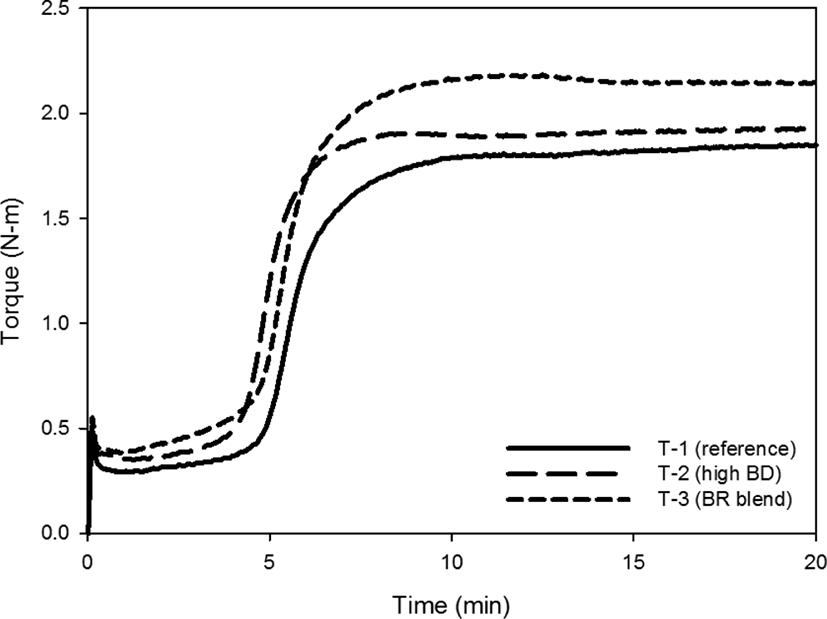
Moving die rheometer (RLR-3; rotorless rheometer, Toyoseiki, Japan)을 이용하여 온도 160°C, 진동 각 ± 1° 조건에서 30분 간 토크 값을 측정하였다.
회전식 점도계의 일종인 Moony viscometer (Mooney visco-meter, Vulchem IND Co., Korea)를 이용하여 metal disk를 회전시키는데 필요한 토크 값을 측정하였다. ASTM D 1646 조건에 따라 1분간 예열한 뒤 4분 동안 100°C 에서 large disk (38.10±0.05 mm, 두께 5.5 ± 0.05 mm)를 2rpm으로 작동시켜 측정하였다.
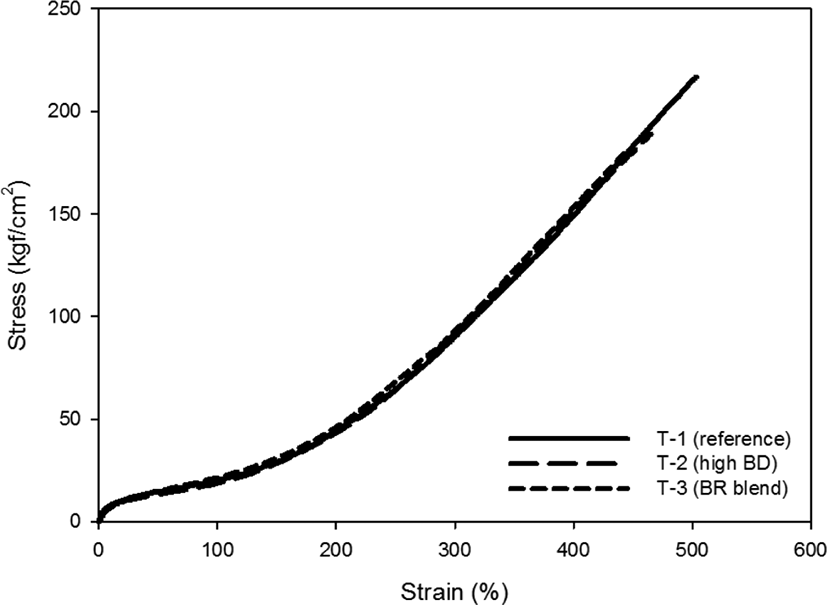
ASTM D412에 조건에 따라 100 mm (길이) × 25 mm (너비) × 2 mm (두께) 규격의 아령 형 시편을 제조하였다. 제조된 시편을 UTM (UTM; KSU-05M-C, KSU Co. Korea)을 이용하여 신장률과 인장강도를 측정하였다. 가황물의 경도는 ASTM D 2240에 따라 shore A type 경도계로 시편을 약 2 Kg (19.6N)의 힘으로 눌러 5번을 측정하여 평균값을 취하였다.
마모 특성은 ASTM D 5963에 따라 지름 16 mm, 높이 8 mm인 원통형으로 시편을 제조하고 DIN 마모시험기로 질량 감소량을 측정하였다.
가황된 시편을 10 mm × 10 mm 크기로 잘라 THF (tetra-hydrofuran) 30 mL, n-hexane 30 mL를 용매로 각각 48시간 sample을 보관하였다. 시간이 지난 후 시편 내부의 유기첨가물을 제거한 후 실온에서 1일간 건조 시켰다. 완전 건조 후 유기 첨가물이 추출된 sample의 중량을 측정하였고, 이 시편을 toluene에 24시간 동안 침지시켜 다시 무게를 측정하였다. 마지막으로 측정된 무게 값들을 아래의 식, Flory-Rehner equation을 사용해 전체 가교 밀도를 계산하였다.
χ: polymer - solvent interaction parameter
v: crosslink density (molg)
Mc: average molecular weight between crosslink points (g/mol)
V1: volume fraction of rubber in the swollen gel at equilibrium
V0: molar volume of solvent (cm3/mol)
ρr: density of the rubber sample (g/cm3).
V1 은 다음 식을 이용하여 구하였다.
Wd: 팽윤 후 건조된 시편의 질량
Wf: 시편에서의 필러의 질량
Ws: 팽윤된 시편의 질량
ρs: 용매의 밀도
ρr: 고무의 밀도
χ는 polymer와 용매의 interaction parameter로 고무의 종류 및 분자량, 용매의 종류, 온도, 가교구조 등에 따라 변한다.
β1: 0.34
V0: molar volume of solvent (cm3/mol)
δp: solubility parameter of polymer
δs: solubility parameter of solvent
추가적으로 가교 구조 분석을 위해 propane-2-thiol (0.4 M), piperidine (0.4 M)을 섞어 n-heptane (50 mL) 용액을 제조했다. 이 용액을 앞서 유기물을 제거한 시편에 넣고 실온에서 16시간 동안 보관한다. 이후 샘플을 꺼내 건조시킨 후 toleune에 24시간 동안 담그고 팽윤 전 후의 중량 차이를 이용하여 폴리 설파이드에 의한 가교 결합을 측정했다.
Results and Discussion
ESBR-1과 ESBR-2 copolymer의 분자량은 Mw 기준 420,000으로 동일하며 분자량 분포 역시 3.5와 3.6으로 유사한 것을 GPC를 통하여 확인하였다.
1H NMR 분석을 통하여 ESBR-1, ESBR-2 copolymer와 NdBR-40의 microstructure를 확인하였다. 1,2-vinyl기는 4.6~5.0 ppm에서 peak를 나타내고 butadiene의 1,4-addition, 1,2-addition은 5.0~5.75 ppm, styrene은 6.7~7.3 ppm에서 peak를 나타낸다. Butadiene의 1,4 addition 중 cis-1,4 addition은 5.3~5.4 ppm에서, trans-1,4 addition은 5.4~5.5 ppm에서 peak를 나타낸다. Monomer의 분자량과 각 peak의 면적을 고려하여 합성한 ESBR copolymer와 NdBR-40의 microstructure 조성을 계산하였다.
또한 DSC를 이용하여 ESBR-1, ESBR-2 copolymer와 NdBR-40의 유리전이온도를 측정한 결과 butadiene의 함량이 높을수록 polymer chain이 쉽게 움직일 수 있기 때문에 유리전이온도가 낮아지는 것을 확인하였다. Butadiene 고무인 NdBR-40의 경우 측정 온도 영역인 −80°C 보다 낮은 유리전이온도를 나타내어 본 기기로는 측정이 불가능하였다. 자세한 결과는 Table 4에 나타내었다.
Cure characteristics과 Mooney viscosity 측정 결과를 Figure 1 및 Table 5에 나타냈다. Butadiene 함량이 증가한 T-2, T-3 컴파운드의 경우 T-1 컴파운드 보다 cure rate가 빨라지는 결과를 나타내는데 이는 allylic position의 증가로 인해 가교 반응에 참여할 수 있는 active site가 늘어났기 때문에 나타난 결과로 판단된다. 또한 T-1 컴파운드 대비 Mooney 점도와 전반적인 토크 값이 높게 형성되었다. Butadiene 함량이 증가할수록 styrene의 함량은 감소하게 되는데, styrene의 aromatic ring은 전자가 풍부하여 silica와 상호작용하여 silica 분산을 향상시킬 수 있다.28 이에 따라 styrene 함량이 적은 T-2 컴파운드는 silica 분산이 불리해져 높은 Tmin, Tmax 토크 값을 나타낸 것으로 판단된다. NdBR이 혼합된 T-3 컴파운드는 blend 시 사용된 BR의 분자량이 크기 때문에 나오는 효과와 더불어 불리한 실리카 분산, 높은 가교 밀도로 인하여 가장 높은 토크 값을 나타내는 것으로 판단된다.
Swelling test를 이용하여 계산된 crosslink density를 Table 6에 나타내었다. Butadiene의 함량이 증가할수록 가교 반응의 active site인 allylic position이 많아져 가교 구조 형성에 유리하지만30 T-2 컴파운드의 경우 silica 분산이 좋지 않아 가교밀도 상승 효과는 미미하였다. T-3 컴파운드의 경우 high cis BR을 blend하여 사용했기 때문에 trans-1,4 butadiene이 많은 T-2 컴파운드보다 mono sulfide 결합을 형성하기 쉽다.31,32 일반적으로 mono sulfide 결합이 많은 컴파운드의 경우 poly sulfide 결합이 많은 컴파운드 보다 높은 가교밀도를 나타낸다고 알려져있다.33,34 이에 따라 high cis BR을 blend한 T-3 컴파운드가 T-2 컴파운드보다 상대적으로 더 높은 가교밀도를 나타내는 것으로 판단된다.
| Sample Code | |||
|---|---|---|---|
| T-1 (reference) | T-2 (high BD) | T-3 (BR blend) | |
| Total crosslink density [10−4 mol/g] | 1.10 | 1.12 | 1.23 |
| Di + mono crosslink density [10−4 mol/g] | 0.55 | 0.59 | 0.64 |
기계적 특성 결과를 Figure 2와 Table 7에, DIN 마모 손실 결과를 Table 8에 나타냈다. T-1~T-3 컴파운드가 M100%과 M300%에서 유사한 값을 나타내었지만, butadiene의 함량이 증가한 T-2와 T-3 컴파운드의 경우 낮은 elongation at break (εb)에 기인한 낮은 tensile strength를 내었으며 NdBR을 혼합한 T-3 컴파운드의 경우 동일한 butadiene 함량을 가지는 T-2 컴파운드 보다 εb 에서 불리한 결과를 나타내었다. 이는 가교도가 높아져 나타난 현상으로 판단되고 고무가 혼합된 경우 copolymer의 경우보다 polymer phase가 상대적으로 heterogeneous하여 더욱 쉽게 파단이 일어나는 것으로 판단된다.16,29 DIN abrasion loss를 통해 마모 성능을 비교 분석한 결과, high cis BR가 사용된 T-3 컴파운드가 가장 우수한 내마모 특성을 나타내었다.
| Sample Code | |||
|---|---|---|---|
| T-1 (reference) | T-2 (high BD) | T-3 (BR blend) | |
| DIN abrasion loss [mg] | 119 | 96 | 76 |
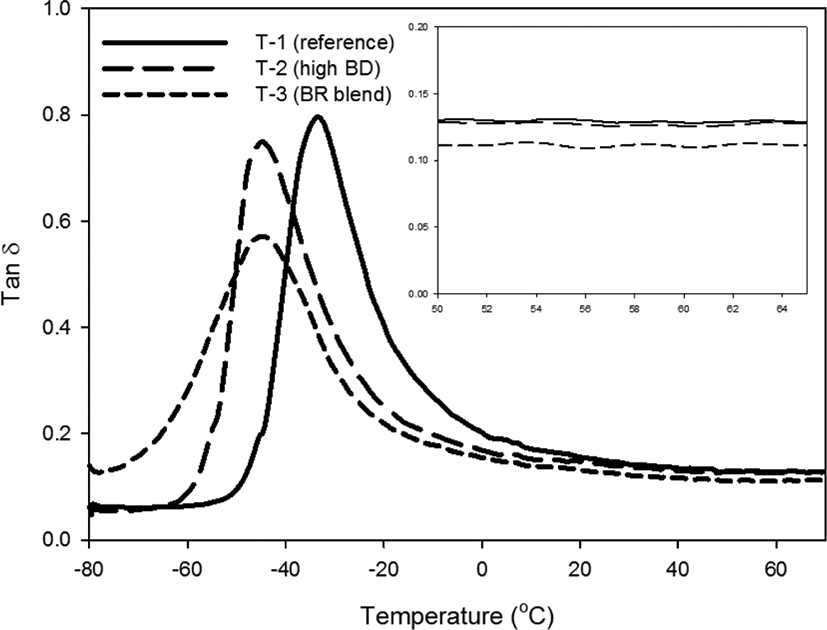
동적 점탄 특성 분석 결과를 Figure 3 및 Table 9에 나타냈다. Styrene 함량이 높은 T-1 컴파운드가 가장 높은 유리전이온도를 나타내었고 cis-1,4 butadiene 함량이 높은 T-3 컴파운드가 가장 낮은 유리전이온도를 나타내었다. 일반적으로 젖은 노면 제동성 지표인 tan δ at 0°C 에서의 tan δ 값은 유리전이온도에 큰 영향을 받기 때문에 젖은 노면 제동성 지표인 tan δ at 0°C 는 T-1 컴파운드에서 가장 높은 값을 나타내었다. 구름 저항성의 지표인 tan δ at 60°C 의 경우에는 가교밀도가 높을수록 free polymer chain에 의한 energy loss가 줄어들기 때문에, 높은 가교밀도를 가지는 T-3 컴파운드에서 가장 낮은 값을 나타내었다.35,36 전반적인 tan δ curves 를 보았을 때 T-3 컴파운드가 다른 두 컴파운드에 비해 tan δ peak 값이 낮고 −80°C 부근에서 tan δ가 상승하는 two peak 형태를 나타내었는데, 이는 T-3 컴파운드의 polymer인 ESBR-1과 NdBR이 partial miscible 하기 때문에 나타난 결과로 판단된다.37-39 이에 따라 ESRB-1에 NdBR이 부분적으로 blend 된 polymer phase는 약 −45°C 에서, blend 되지 않은 NdBR의 경우 −80°C 이하에서 Tg를 나타내어 ESBR과 BR 사이에 phase separation을 확인할 수 있다.40 또한 유리전이온도에서의 tan δ peak 역시, phase separation에 의하여 BR phase의 energy dissipation이 −80°C 이하에서 이루어지기 때문에41 T-1과 T-2 컴파운드에 비해 낮은 tan δ peak 값을 나타내는 것으로 판단된다.
| Sample Code | |||
|---|---|---|---|
| T-1 (reference) | T-2 (high BD) | T-3 (BR blend) | |
| Tg [°C] | −33.6 | −44.8 | −45.2, < −80 |
| tan δ at 0°C | 0.202 | 0.169 | 0.155 |
| tan δ at 60°C | 0.128 | 0.126 | 0.111 |
Conclusions
컴파운드 내에 butadiene의 함량이 증가하면 반응성이 우수한 allylic position이 증가하여 cure rate가 빨라지는 것을 확인하였지만 copolymer를 사용한 T-2 컴파운드의 경우 silica 분산이 불리하여 가교 밀도의 상승은 상대적으로 미미하였다. 이에 반해 high cis BR이 blend 된 T-3 컴파운드는 mono sulfide 결합을 쉽게 형성할 수 있기 때문에 poly sulfide 결합이 많은 T-2 컴파운드 보다 우수한 가교 밀도를 나타내었다.
기계적 특성에서 가교 밀도가 높아짐에 따라 εb 이 짧아져 tensile strength가 낮아지는 경향을 나타내었다. 특히 high cis BR이 blend된 T-3 컴파운드는 높은 cis-1,4 butadiene 함량으로 인하여 가장 우수한 내마모 특성을 나타내었다. T-3 컴파운드의 phase separation은 동적 점탄 특성 결과에서 확인 할 수 있으며, phase separation에 의해 낮은 tan δ peak 값을 나타내었다. 또한 T-3 컴파운드의 경우 ESBR과 NdBR의 partial partial miscibility로 인하여 두 개의 유리전이온도를 나타내었으며, high cis NdBR이 blend된 T-3 컴파운드에서의 높은 가교밀도로 인하여 우수한 구름 저항성을 나타내었다.
따라서 SBR/BR blend 컴파운드와 동일한 butadiene 함량을 가지도록 합성한 ESBR copolymer를 사용하여 컴파운드를 제조할 경우 high cis NdBR보다 copolymer 내 BR의 cis-1,4 butadiene의 비율이 낮아 내마모성과 가교밀도, 구름 저항성이 불리한 결과를 나타내었다.
References
1.

2.
3.

4.
7.
8.
9.
11.

12.

13.
14.
15.
16.
17.
18.
19.
20.
21.
22.
23.
25.
26.
27.
28.
29.
30.
31.
32.
33.
34.
35.
36.
38.
39.