

Abstract
Nanorod graphitic carbon nitride (g-C3N4) was synthesized by reacting melamine (C3H6N6) with trithiocyanuric acid (C3H3N3S3) in distilled water for 10 h at room temperature. The resulting mixture was calcined at 550°C for 2 h in an electric furnace under an air atmosphere. Nanorod g-C3N4/Ag3PO4 composites were prepared by adding nanorod graphitic carbon nitride (g-C3N4) powder, silver nitrate (AgNO3), ammonia (NH3·H2O, 25.0-30.0%), and sodium hydrogen phosphate (Na2HPO4) to distilled water. The samples were characterized via X-ray diffraction, scanning electron microscopy, and Fourier-transform infrared spectroscopy. The photocatalytic activities of the nanorod g-C3N4/Ag3PO4 composites were demonstrated via the degradation of organic dyes, such as methylene blue and methyl orange, under blue light-emitting diode irradiation and evaluated using UV-vis spectrophotometry.
Keywords: Nanorod g-C3N4;Ag3PO4;photocatalytic activities;organic dyes;blue LED
Author information and publication history
Received: Jan 09, 2024; Revised: Feb 14, 2024; Accepted: Feb 21, 2024
Published Online: Mar 31, 2024
Introduction
Wastewater from the textile industry contains large amounts of dyes that can be harmful to the environment.1,2 Dyes are a significant water pollutant in the wastewater of textile, leather, food processing, dyeing, cosmetics, paper, and dye manufacturing industries.3,4 Fortunately, the problem of water pollution from dyes has been solved with semiconductor photocatalytic technology.5-7 The degradation of organic pollutants using photocatalysis is a very promising method that accessed as an economical and environmentally friendly solution.8,9 Among the photocatalysts, titanium oxide (TiO2)-based nanomaterials are considered among the most reliable photocatalytic materials for degrading toxic and hazardous organic pollutants.10,11 However, TiO2 is only responsive to wavelengths in the ultraviolet light, which can absorb only 4% of the solar spectrum.12 Therefore, there is need to enhance the photocatalyst capability to absorb solar energy.13,14
Among semiconductor photocatalysts, graphite-like carbon nitride has attracted huge attention due to its unique properties, such as high chemical stability, high thermal and photochemical stability, strong mechanical properties, and nontoxicity.15,16 Graphitic carbon nitride forms a 2D layer derived from the tri-s-triazine unit structures of carbon and nitrogen. These 2D layers are stacked together by strong van der Waals forces.17,18
Since the discovery by Wang’s group in 2009, metal-free graphite nitride (g-C3N4) has received considerable attention from scientists.19 The g-C3N4 has been reported as a metalfree polymer-like semiconductor photocatalyst with thermal and chemical stability as well as low cost.20 The g-C3N4 photocatalyst has a bandgap of 2.7 eV and can absorb light up to 450 nm.21 However, the application of single g-C3N4 photocatalyst has been limited by high electron-hole recombination and low specific surface area.22 To overcome the limitation of photocatalyst, several strategies, such as combinations with metals and non-metals and heterojunction configurations, have been used for g-C3N4.23,24
Ag3PO4 photocatalyst has received great attention owing to its bandgap (2.45 eV) and excellent visible light-driven photocatalytic activity for the degradation of organic pollutants.25,26 Ag3PO4 contains an electric field between the PO 3- and Ag+ ions, resulting in a quantum efficiency of approximately 90% at 400-480 nm due to the separation of the photoelectron-hole pairs.27,28
In this study, the photocatalytic activities of the nanorod gC3N4/Ag3PO4 were investigated to remove organic dyes, such as MB and MO, under blue LED (at 450 nm).
Experimental
Melamine (C3H6N6), sodium hydrogen phosphate (Na2HPO4) and trithiocyanuric acid (C3H3N3S3) were purchased from Alfa Aesar. Ammonia solution (NH3·H2O 25.0%~30.0%), ethyl alcohol (C2H5OH 99.9%), methylene blue (MB), methyl orange (MO) and silver nitrate (AgNO3) were purchased from Samchun Chemicals.
XRD pattern and crystallite size of the synthesized samples were obtained using X-ray diffraction (Bruker, D8 Advance) with a Cu Kα radiation source (λ=1.54178 Å). The surface morphology was investigated using SEM (JEOL Ltd, JSM6510) at an acceleration voltage of 20 kV. FTIR analysis was performed using a Thermo Fisher Scientific instrument with sample powders diluted in KBr pellets. Photocatalytic degradation of the organic dyes was conducted using a UV-vis spectrophotometer (Perkin-Elmer) in the wavelength range of 200-800 nm with a Lambda 365. The organic dye solution was irradiated with visible light using blue LED (5W, 450 nm, T5 Jinsung Electronic., Ltd).
Typically, to 100 mL of distilled water, 1.261 g of melamine (C3H6N6) and 1.773 g of trithiocyanuric acid (C3H3N3S3) were added, followed by stirring at room temperature for 10h. The resulting faint yellow precipitation was washed thrice with ethanol by centrifugation. The product was dried at 60°C for overnight, then calcined in an electric furnace at 550°C for 2 h at heating rate of 5°C/min in air atmosphere.
To synthesize the nanorod g-C3N4/Ag3PO4 composite, 0.3 g of the synthesized nanorod g-C3N4 powder was dispersed in 100 mL of distilled water under ultrasonic irradiation for 60 min. 0.17 g of silver nitrate was dissolved in 20 mL of distilled water. The silver nitrate solution was stirred into the suspended nanorod g-C3N4 solution using a magnetic stirrer for 30 min.
0.1 M of an aqueous ammonia solution was added dropwise to the solution at room temperature for 50 min. Then, 0.426 g of sodium hydrogen phosphate was dissolved in 15 mL of distilled water, added dropwise and mixed solution was stirred for 30 min. The product was washed thrice with ethanol and dried at 60°C for 12 h.
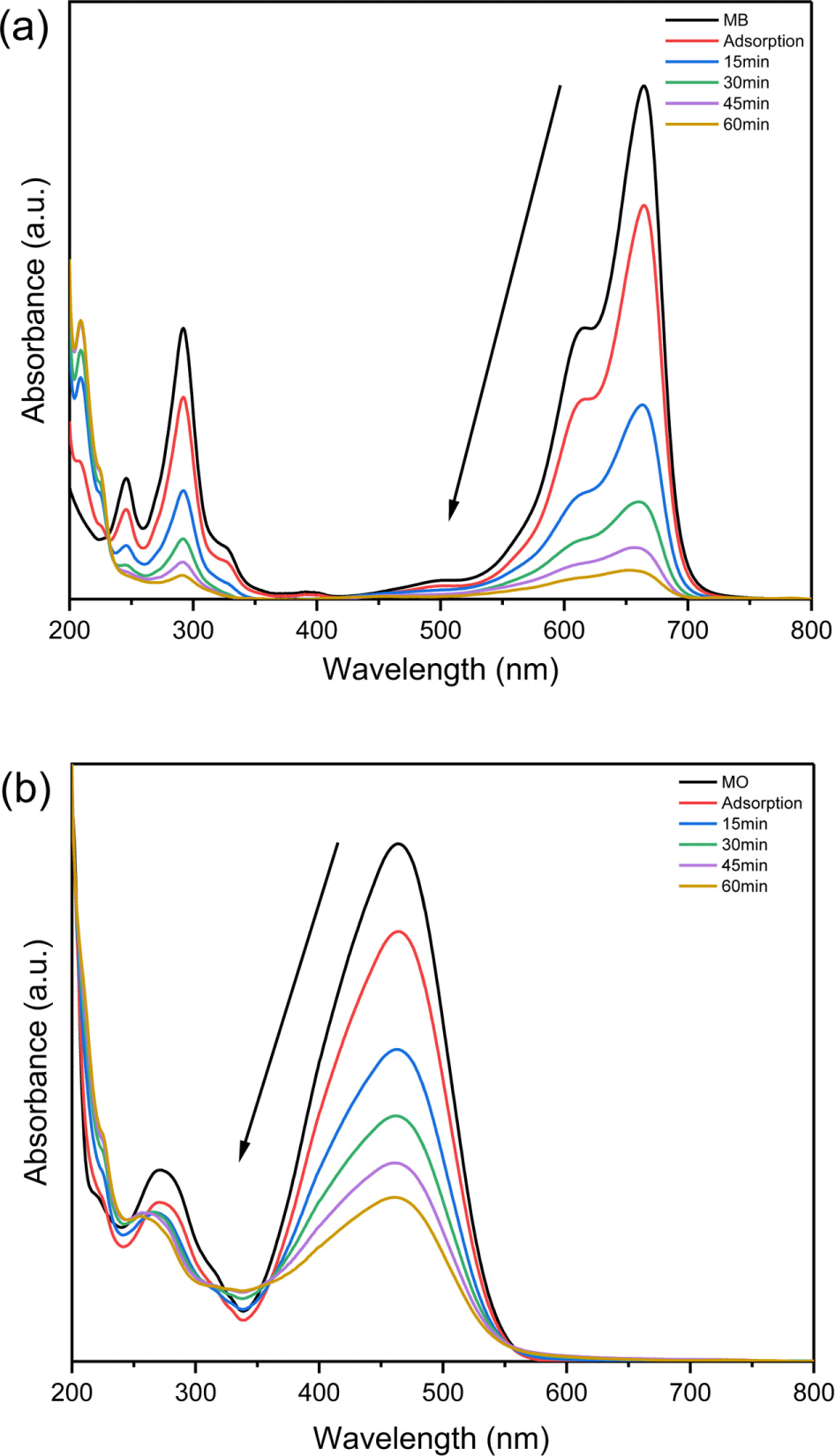
The concentration of MB and MO in the organic dye solution was 0.63 × 10⁻² mM and 3.67 × 10⁻² mM, respectively. The MB solution exhibited an absorption peak at 665 nm and the MO solution exhibited an absorption peak at 464 nm. The photocatalyst powder (5 mg) was added to a conical tube which containing 10 ml of an aqueous organic dye solution. To achieve adsorption-desorption equilibrium between the organic dye solution and photocatalysts, the conical tubes were kept in the dark environment for 15 min. The blue LED was used to provide a visible light source at a distance of 1 cm between the LED and the aqueous organic dye solution. The photocatalytic degradation of the organic dye was analyzed using a UV-vis spectrophotometer, monitoring at 15 min intervals.
Results and Discussion
Figure 1 shows the XRD pattern of the nanorod g-C3N4/ Ag3PO4 composites. Peaks at 2θ = 13.1° and 27.6° were owing to the nanorod g-C3N4 and were assigned to the (100) and (002) planes, respectively. The main peak at 2θ = 27.6° can be indexed to the (002) plane of graphite-like materials (JCPDS card no. 87-1526).29-31 Peaks at 2θ = 20.93°, 29.75°, 33.35°, 36.64°, 42.56°, 47.87°, 52.74°, 55.08°, 57.33°, 61.73°, 66.09°, 69.98°, 71.97°, and 74.24° correspond to the (110), (200), (210), (211), (220), (310), (222), (320), (321), (400), (330), (420), (421), and (332) planes of Ag3PO4 (JCPDS file No. 06-0505).32-34 No other diffraction peaks were observed for the nanorod g-C3N4/Ag3PO4 composites. The crystallite size of the Ag3PO4 was calculated using the Scherrer equation35:
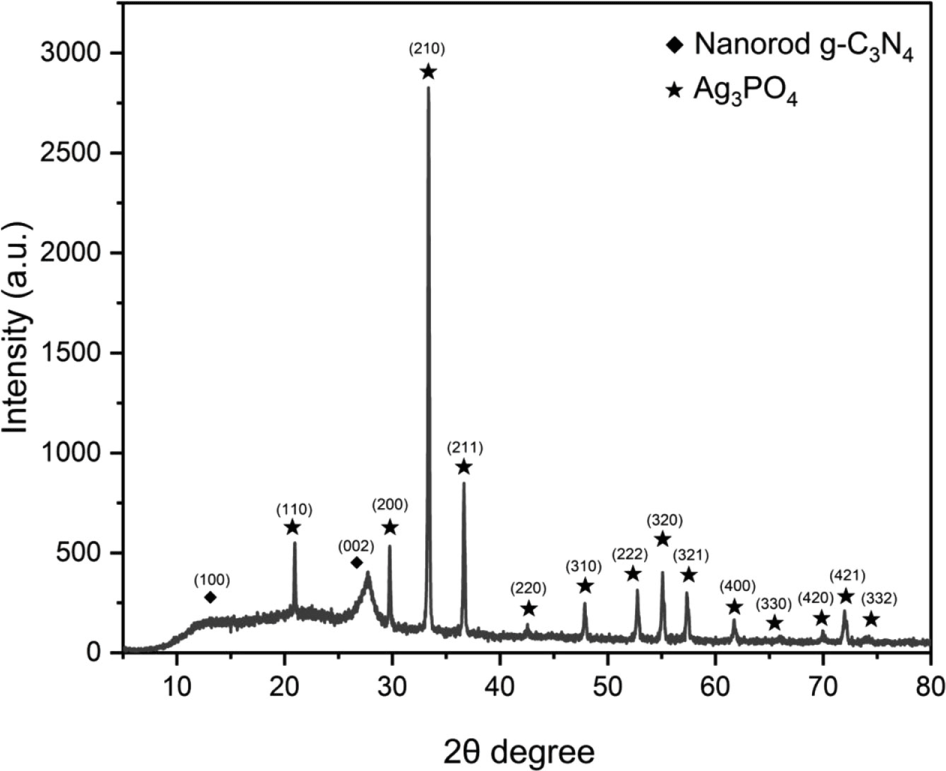
where D is known as the crystallite size (nm), K is the Scherrer constant taken as 0.9, λ is the wavelength of the X-ray diffraction with Cu Kα, (λ = 1.5418 Å), β is the full width at half maximum (FWHM), and θ is the Bragg angle in degree. Table 1 shows the crystallite size of the Ag3PO4 at (200), (210), and (211) planes and the mean crystallite size of the Ag3PO4.
| (hkl) | 2θ | FWHM | Crystallite size (nm) |
|---|---|---|---|
| (200) | 29.75° | 0.144 | 59.64 |
| (210) | 33.35° | 0.171 | 50.67 |
| (211) | 36.64° | 0.194 | 45.07 |
| Average | 51.79 |
Figure 2 shows the surface morphology of the nanorod gC3N4/Ag3PO4 composites obtained using SEM. The SEM image shows two distinct structural morphologies in the synthesized nanorod g-C3N4/Ag3PO4 composites. Nanorod gC3N4 exhibited an obvious one-dimensional rod shape, whereas Ag3PO4 had a cubic shape.
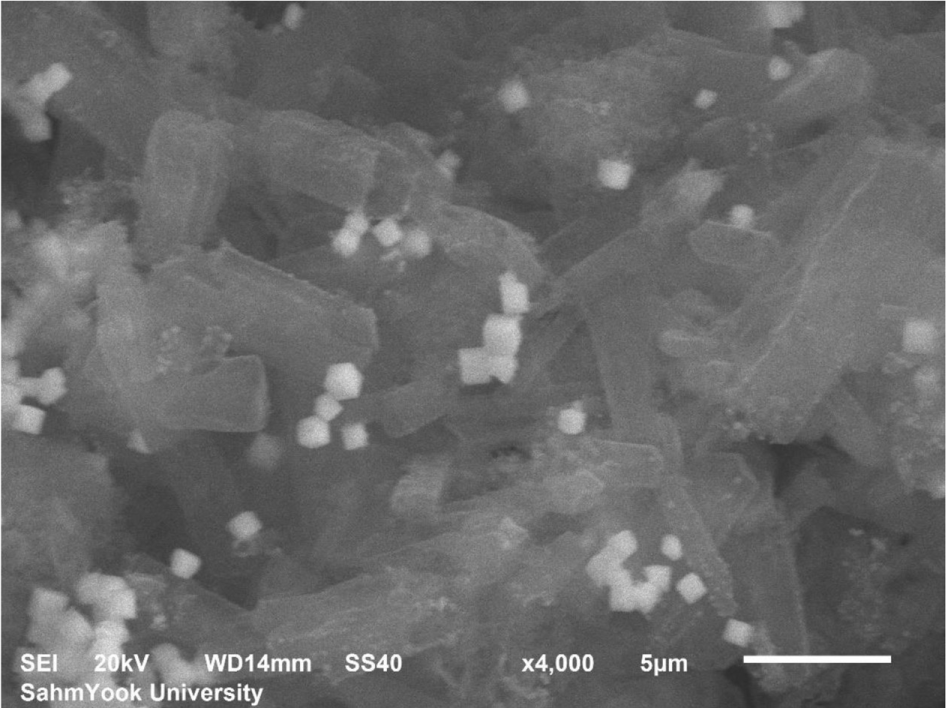
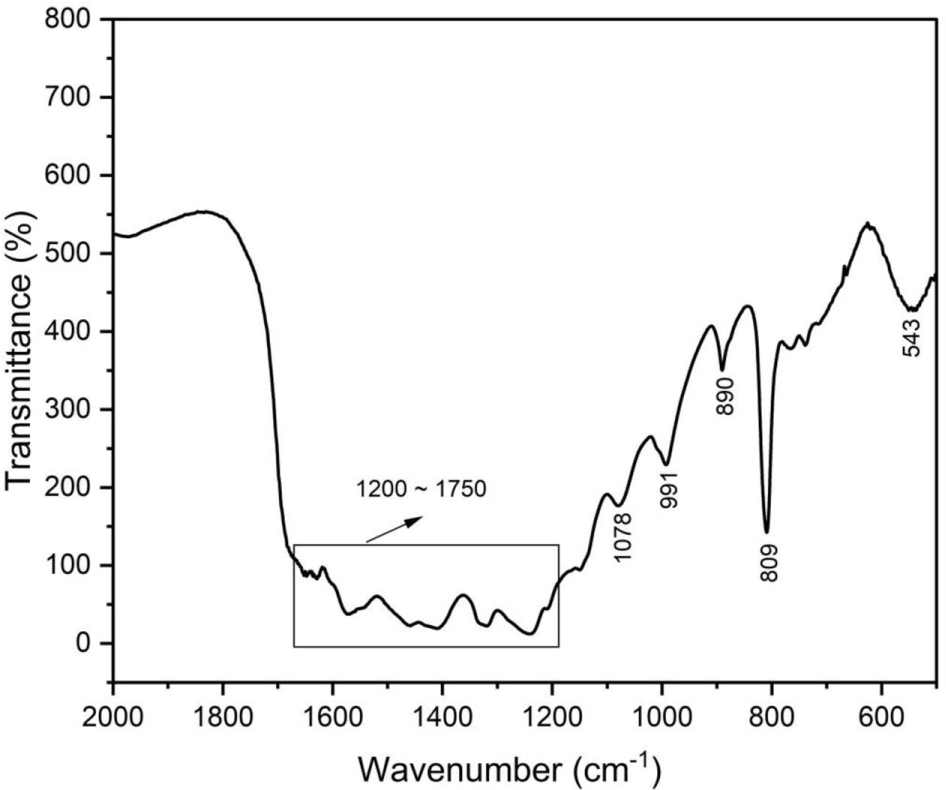
Figure 3 shows the FTIR spectrum of the nanorod g-C3N4/Ag3PO4 composites used to characterize the various functional groups and interactions between the nanorod gC3N4 and Ag3PO4. For nanorod g-C3N4, the sharp peaks at 809 and 890 cm-1 are attributed to the tri-s-triazine unit. The peaks in the range of 1200-1750 cm-1 are attributed to the aromatic CN heterocycles. 36-38 For Ag3PO4, the peaks at 543 cm-1 and 991 cm-1 are related to the P-O stretching vibration mode of PO 3−. The peak at 1078 cm-1 was attributed to the asymmetric stretching vibrations of the P-O-P group.39-41
To study the photocatalytic degradation efficiency (PDE) of organic dyes such as MB and MO, the nanorod g-C3N4/Ag3PO4 composites were irradiated using blue LED at 450 nm. The PDE was calculated using the following equation42:
where C0 represents the initial concentration of the organic dyes solution and Ct represents the concentration of the organic dyes solution at a certain time t. I0 represents the intensity of the maximum absorbance peak in the UV-vis spectrum of the initial organic dye solution and It represents the intensity of the maximum absorbance peak in the UV-vis spectrum of the organic dyes solution at a certain time t.
Figure 4 shows the UV-vis spectra of photocatalytic degradation of MB and MO. The PDEs of MB and MO under blue LED irradiation were 93.24% and 61.94%, respectively. The photodegradation activity of the nanorod g-C3N4/Ag3-PO4 composites was higher for MB than MO.
In the Langmuir-Hinshelwood kinetic model, the photocatalytic activity of MB and MO can be represented by the following apparent pseudo-first-order kinetic equations43:
where C0 represents the initial concentration of the organic dye solution, C represents the concentration at time t, and K is the rate constant of photocatalytic degradation.
MB has cationic properties that allow it to interact with anionic species, such as hydroxyl groups and superoxide anion radicals, on the photocatalytic surface. By contrast, MO tends to react with cationic species such as holes due to its anionic nature.44 These difference can be attributed to the cationic and anionic properties of organic dye molecules. Figure 5 shows the results of kinetics study for MB and MO. Therefore, the MB had higher photocatalytic degradation efficiency and kinetics rate than for MO.
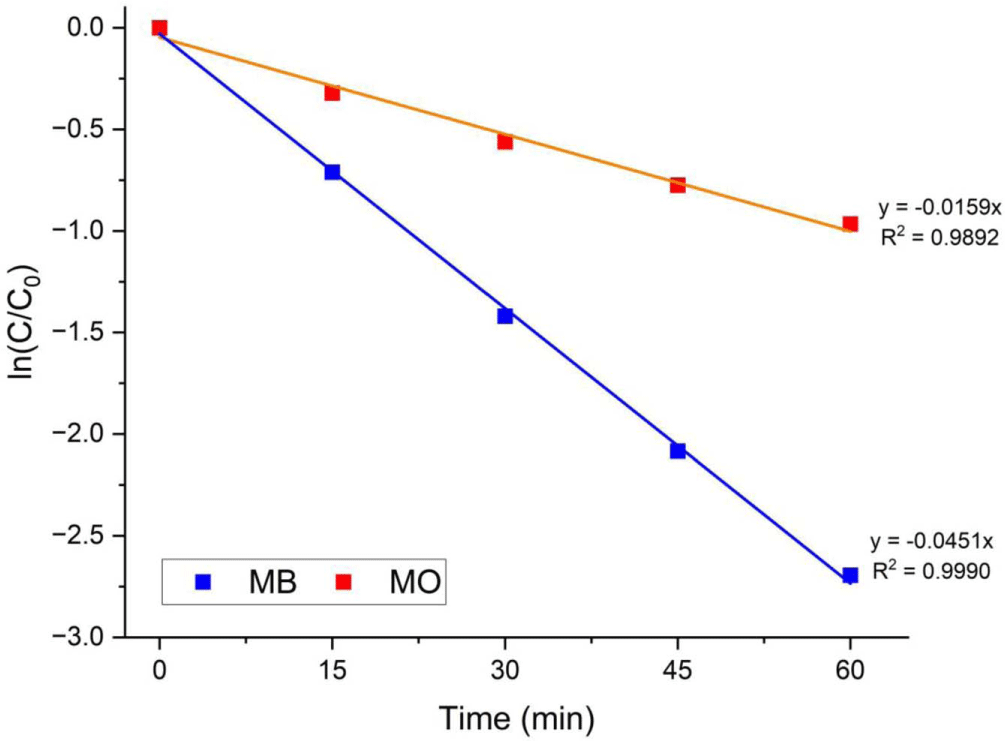
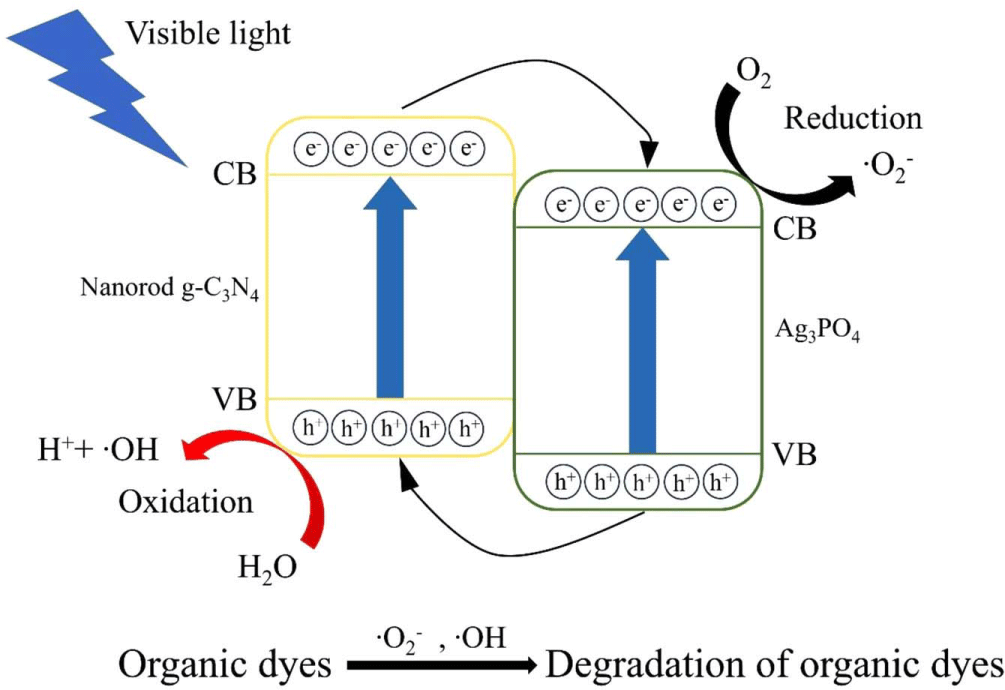
Figure 6 illustrates the mechanism of the photocatalytic degradation of organic dyes using nanorod g-C3N4/Ag3PO4 composites. Under visible light, photogenerated electrons move from the conduction band of nanorod g-C3N4 to the Ag3PO4, while holes move from the valence band of Ag3PO4 to the nanorod g-C3N4, showing that the hybrid photocatalysts efficiently separate the photogenerated charges and reduce the recombination of electron-hole pairs. Consequently, water (H2O) is oxidized through the holes (h+) present in the valence band of the nanorods g-C3N4 to form hydroxyl radical (·OH), while oxygen (O2) is reduced by electrons (e-) from the conducting band of Ag3PO4 to form superoxide anion radical (·O2-). The electron and hole pairs can be generated the superoxide anion radicals (•O2-) and hydroxyl radicals (•OH) species to efficiently degrade organic pollutants.45,46
Conclusions
Rod-like g-C3N4 was obtained from precursors, such as melamine and trithiocyanuric acid. Nanorod g-C3N4/Ag3PO4composites were synthesized by adding nanorod g-C3N4 product and silver nitrate (AgNO3), ammonia (NH3·H2O 25.0%-30.0%), and sodium hydrogen phosphate (Na2HPO4) to distilled water. The nanorod g-C3N4/Ag3PO4 composites were characterized using XRD, SEM and FT-IR. The synthesized hybrid photocatalyst was evaluated for the degradation of MB and MO under blue LED irradiation. The photocatalytic degradation processes were observed using a UV-vis spectrophotometer. The degradation of the organic dye process followed pseudo-first-order kinetics. Furthermore, the photocatalytic activity of the nanorod g-C3N4/Ag3PO4 composites for MB degradation under visible light was higher than for MO.
References
1.


2.
3.
4.

5.

6.
7.
8.
9.
10.
11.
12.
13.
14.
15.
16.
17.
18.
19.
20.
21.
22.
23.
24.
25.
26.
27.
28.
29.
30.
31.
32.
33.
34.
35.
36.
37.
38.
39.
40.
41.
42.
43.
44.